


Key Takeaways
- Tube bending services can reduce fittings and potential leak points.
- CNC tube bending improves consistency and repeatability.
- Precision tube bending supports cleaner system layouts.
- High-purity industries often benefit from custom bent tubing assemblies.
- Axenics allows ±.030 inch to ±.060 inch for CNC bending tolerances, depending on the application and material springback.
Manufacturers across semiconductor, medical device, and high-purity industries continue looking for ways to improve system performance while reducing unnecessary complexity. One area that can have a major impact is tubing layout. Excess fittings, difficult routing paths, and inconsistent fabrication can all introduce challenges that affect performance over time.
Axenics provides precision tube bending services and fabrication support for manufacturers across semiconductor, medical device and other high-purity industries. Our capabilities support custom components and assemblies built to customer drawings and specifications.
What Counts as Tube Fabrication?
Tube bending is one part of tube fabrication. Depending on the component or assembly, fabrication can also include cutting, welding and assembly to produce a finished part to customer specifications.
That distinction is especially relevant for high-purity work. A bent tube may also require welded connections, specific cleaning or handling procedures, inspection and testing before it becomes part of a gas delivery, fluid handling or other process system.
We provide build-to-print tube fabrication based on customer drawings and specifications. Our capabilities include tube cutting, CNC tube bending, manual bending, welding and assembly, allowing multiple fabrication processes to be completed within the same manufacturing workflow.
Benefits of Tube Bending Services
Tube bending offers several advantages compared to systems that rely heavily on fittings and multiple welded connections. By creating smoother, continuous tubing paths, manufacturers can often reduce potential leak points while improving flow and simplifying installation.
Precision tube bending can also help:
- Reduce assembly complexity
- Improve routing consistency
- Lower maintenance requirements
- Reduce pressure drops
- Improve overall system appearance and organization
In high-purity manufacturing environments, reducing unnecessary connection points can also help minimize contamination risk.
How CNC Tube Bending Reduces Leak Points
Every fitting added to a tubing system creates another possible failure point. While fittings are necessary in many applications, excessive use can increase the potential for leaks, maintenance issues, and system inefficiencies.
CNC tube bending services allow manufacturers to replace multiple fittings with smoother continuous bends that simplify routing and reduce the number of connections throughout the assembly. This approach is especially valuable in systems where reliability and cleanliness are critical. Fewer fittings can help improve long-term performance while supporting easier inspection and maintenance.
Tolerances and Materials for High-Purity Tube Fabrication
Material, tube dimensions, wall thickness and bend radius all affect the finished bend. Axenics works with stainless steel, copper, brass, aluminum, titanium and Inconel, with 300-series stainless steel commonly used for its CNC tube bending work. This tube bending radius chart documents standard or commonly requested combinations including:
- ¼-inch stainless steel tubing with ½-inch and 9/16-inch bend radii
- ⅜-inch stainless steel or copper tubing with a 15/16-inch bend radius
- ¾-inch stainless steel or aluminum tubing with a 1⅛-inch bend radius
- 1-inch stainless steel or aluminum tubing with a 1½-inch bend radius
- 1¼-inch stainless steel or Inconel tubing with a 2-inch bend radius
- 1½-inch stainless steel tubing with a 2¼-inch bend radius
These represent common configurations rather than the full capability of the machine. Other tube sizes and bend radii may require additional tooling.
Material springback affects achievable bending tolerances. When machining tolerances are applied to CNC bending work, Axenics asks for an allowance of ±.030 inch to ±.060 inch, depending on the application.
Wall thickness, material and bend radius also affect the amount of support required during forming. Mandrel bending supports the inside of the tube during the bend to help control distortion in applications that require it. More detail on these variables is available in factors that affect tube bending results.
Tube Bending Services for High-Purity Applications
In semiconductor, medical device, biotechnology, and other high-purity industries, tubing systems often need to meet strict cleanliness and performance requirements. Precision tube bending services support cleaner layouts while reducing potential leak and contamination risks.
Stainless steel tube bending is commonly used in these environments because of the material’s durability, corrosion resistance, and compatibility with high-purity applications.
Our tube fabrication services support manufacturers that require:
- Tight tolerances
- Consistent repeatability
- High-purity stainless steel tubing
- Cleanroom-compatible fabrication
- Complex routing configurations
- Integrated fabrication and assembly support
For components with high-purity requirements, fabrication may also include controlled material handling, cleaning, inspection and testing based on customer specifications. Axenics maintains Class 100 cleanroom capability for work requiring a controlled manufacturing environment.
Tube Bending and Fabrication for Complex Assemblies
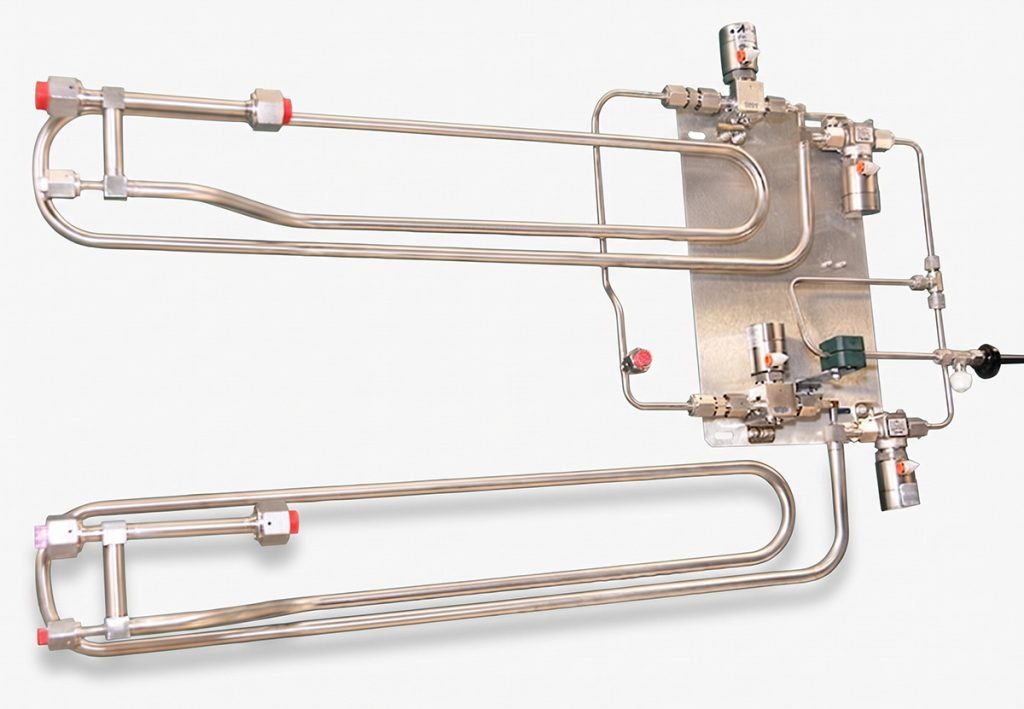
Tube bending can be integrated with welding and assembly when a component cannot be produced through bending alone. Custom tube assemblies may combine bent stainless steel tubing, welded connections and custom routing for gas delivery, fluid handling and high-purity process applications.
Reducing unnecessary fittings while retaining the connections required by the customer design can simplify the finished assembly and improve repeatability across production.
Choosing the Right Tube Fabrication Partner
High-purity tube fabrication can require more than bending capability. The customer’s specifications may extend across multiple fabrication processes and establish requirements for the completed component or assembly.
Axenics combines CNC and manual tube bending with welding, assembly and testing for build-to-print components and assemblies. Our Horn Metric TBRE Hybrid CNC Bender provides both mandrel and roll bending capabilities, while manual bending remains available for work that is not suited to the CNC process.
We also maintain an ISO 9001:2015-certified quality system, Class 100 cleanroom capability and welding certifications including AWS D1.6 and ASME Section IX. Completed work is inspected and helium leak tested before leaving the facility, with additional testing performed based on customer requirements.
Keeping bending, welding, assembly, inspection and testing within the same manufacturing workflow can also reduce the number of handoffs required to complete a tube assembly. For recurring production, the same customer drawings and specifications remain the basis for each build, while inspection and testing requirements can be incorporated into the production process.
That continuity is particularly relevant for high-purity components that may move through several fabrication steps before shipment. Material requirements, fabrication specifications and required documentation can remain tied to the job as it moves from bending and welding through final inspection and testing.
Contact us to discuss your tube fabrication requirements.
What are tube bending services?
Tube bending services involve shaping tubing into precise configurations for fluid handling, gas delivery, and manufacturing systems while reducing unnecessary fittings and welds.
What are the benefits of CNC tube bending?
CNC tube bending improves consistency, repeatability, and accuracy while helping reduce leak points and simplify installation.
What's the difference between tube fabrication and tube bending?
Tube bending is the process of forming tubing to a specified geometry. Tube fabrication is broader and can include cutting, bending, welding and assembly to produce a finished component or tube assembly.
What tolerances can Axenics hold for high-purity tube fabrication?
Tolerance requirements vary with the material, tube dimensions, bend radius and application. When machining tolerances are applied to CNC bending work, Axenics asks for an allowance of ±.030 inch to ±.060 inch to account for material springback.
Why is tube bending important in high-purity manufacturing?
Tube bending can reduce connection points within a system, helping lower contamination and leak risks in high-purity environments.
What industries use precision tube bending?
Precision tube bending is commonly used in semiconductor, medical device, biotechnology, and industrial manufacturing applications.
What materials are commonly used in tube bending?
Stainless steel is commonly used in high-purity tube fabrication, and 300-series stainless steel is the primary metal tubing Axenics runs on its CNC bender. Axenics also bends copper, brass, aluminum, titanium and Inconel based on customer specifications.
Why does high-purity tube fabrication need a specialized manufacturing partner?
High-purity components can carry requirements beyond the finished dimensions, including material handling, cleanliness, weld quality, inspection and testing. Axenics combines these capabilities with tube bending and fabrication to execute customer specifications within a controlled manufacturing process.

