
Precision Tube Bending
We offer manual and Computer Numerical Controlled (CNC) bending services, depending on the desired size and quantity of bends. We also provide custom bending services, allowing bending to precise customer specifications.
Experts in Tube Bending Services
Our technicians provide precision stainless steel tube bending services as well as bending in a variety of other metals, including: Inconel, titanium, copper, aluminum and several additional alloys. We are capable of bending tubing that ranges in size from 1/16-inch to 2 inches. Our expert bending technicians have years of experience and are highly trained to provide the most accurate bends possible.
All of our bends are helium leak-tested before they leave the facility as a part of our strict quality policy. Bending reduces the possibility of leaks that can occur with welded joints. With tube bending, there is also a smaller chance that contaminants will enter the high-pressure gas and liquids flowing through pipes.
For larger tubing and/or higher quantities of tube bending services, we use an automated CNC tube bender.

What is included in the cost?
Are tube bending services tested for quality?
This is a valuable benefit because it ensures that the quality of the components and/or assemblies produced matches industry standards, as well as any specific requirements your organization might have. We test all work that we do in our facility, in addition to offering testing based on customer requests, in which case, we test to client specifications.
What is the skill level of the manufacturer?
Is it a one-time project or ongoing?
Perfecting the art of precision tube bending
Precision tube bending is a rigorous process that requires a skilled mechanical mindset and proven processes in order to perform correctly – and consistently. While there are numerous companies that list tube bending within their overall capabilities, few have been able to perfect the art of precision tube bending. To understand the skill required for this type of tube bending, you must first have an understanding of what the end result should look like.
Preventing imperfections
Precision tube bending is the process of creating tubes that are bent without any inside or outside diameter imperfections: no wrinkling, and minimal wall thinning or flattening. Wrinkling is an unsightly feature that can occur on the outside diameter, inside of the bend radius. Wrinkling is a condition that most industries will not tolerate, especially the aerospace, semiconductor and medical industries.
While every aspect of the process requires attention to detail, the most difficult of these requirements is to prevent wrinkling in a bend. The art of cold bending without wrinkles involves a precise combination of many factors, including exact insertion depth of the mandrel; proper clamp die and backing block pressure; and draw speed.
Another key factor that results in no wrinkles is the use of the right type and viscosity of bending/drawing oil.
Successful precision tube bending also requires that there be no clamp or backing block marks on the tubing. The tube needs to be held tight as it is being pulled around the radius block during the process.
There is a fine line between holding it secure enough to make sure it doesn’t slip, and holding it too tight, putting clamp marks in the outside diameter of the tube.
Industry-specific procedures
Since the semiconductor industry does not allow any oils to be used in the bending process, welded tees and elbows are used to compensate for tight-radius tube bending in this industry.
This procedure is followed because, in most cases, the inside diameter of tubing for the semiconductor sector is electro-polished. Electro-polishing is required in semiconductor tubing, as these tubes usually carry high-purity gas within them. Hence, the chance of any material flaking off and contaminating the chip-making process would be disastrous.
Wall thinning and flattening
Wall thinning and flattening is another factor that comes into play when performing precision tube bending. The tighter the bend radius, the greater the chances of wall thinning and flattening, so attention to detail is critical. Most industries will only tolerate 10 percent or less of wall thinning and flattening in precision tube bending.
When bending tubes, you are essentially stretching/thinning the outer diameter of the bend, while at the same time compressing/thickening the inner diameter of the bend. When the material on the inner diameter of the bend starts to thicken, it will have a greater tendency to form wrinkles.
Therefore, wall thinning and wrinkling often go hand in hand. The art of precision tube bending is controlling either from happening during the process.
Knowledge and equipment
The art of precision tube bending success is a combination of expert knowledge of the material being bent, skilled expertise, and using the proper equipment during the process. Each of these factors must be aligned in perfect harmony in order to achieve the consistent quality most high-tech industries require for defect-free, bent tubular assemblies.
Uncover benefits of tube bending for your next project
Bending Process
Our metal bending process uses several bending tools, hand benders and/or our automated CNC tube bender, depending on the specific project requirements. We use mandrels which help to maintain the shape of the tubing and prevent the unit from collapsing.
Tubing is created using a variety of tube bending processes, which most commonly include ram-type bending, roll bending, compression bending, and rotary draw bending. Each process uses different seam configurations depending on the materials used and the look and/or shape desired. Welded, open, and lock-seams are the main seam types; however, seamless tubing may also be produced for a cleaner look, among other reason
Benefits of Precision Tube Bending
Tube bending is often used in the semiconductor and chemical industries for liquid and gas delivery, predominantly for cooling purposes. The benefits of this process include leak prevention, cost savings and a smoother finish. We can redesign your tube systems to fit into limited space requirements without slowing down your operations.
Another benefit of bending instead of welding is that welds can deteriorate faster from vibrations when placed into large machinery. Vibration fatigue and failure can be a problem with some moving mechanical systems and equipment. Bending results in longer-lasting tubing.
Hand bending requires a low initial investment, and the tools are easy to operate. Hand bending tools are also portable and safe to operate.
CNC Tube Bending
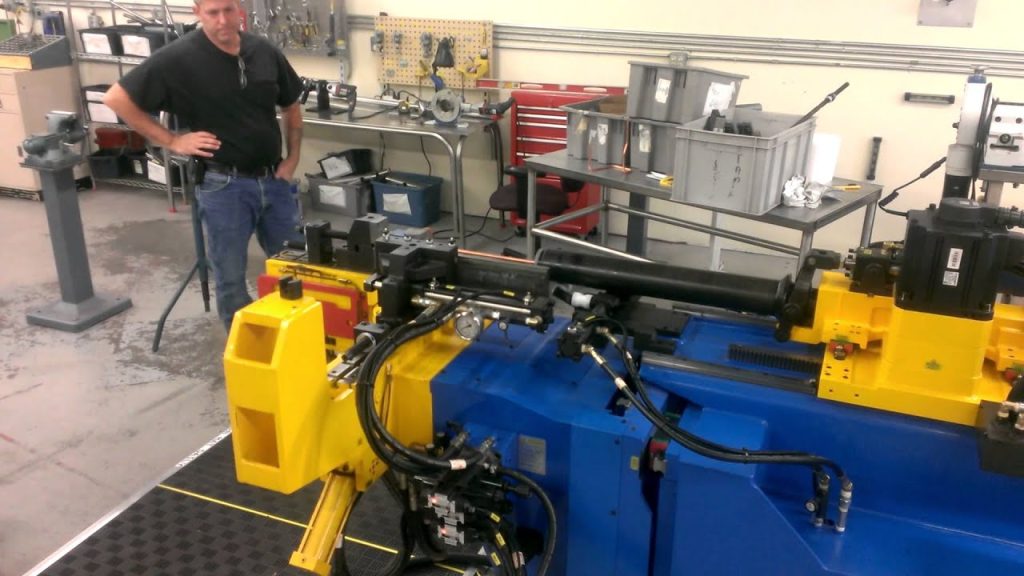
At Axenics, we offer Computer Numerical Controlled (CNC) tube bending services for larger tube bends and for customers requesting high-quantity tube bending services. We use the latest Horn Metric TBRE Hybrid CNC tube bender. We have the ability to work with all of the major alloys including; copper, brass, aluminum, stainless steel, titanium and Inconel.
Utilizing CNC tube bender capabilities ensures that your tubes are free of deformities, are bent accurately to your desired requirements and are delivered on time.
Benefits of CNC Tube Bending
CNC bending provides a more precise, automatic and repeatable process than manual tube bending. Compared with manual bending, CNC tube bending machines can accurately control the degree of a bend, the distances between bends and the plane of the bend. CNC bending allows for maximum accuracy due to its higher degree of control within the process.
This computerized and automated tube bending process makes it possible to perform more complex bending processes than manual bending and increases overall operational efficiency.
We position the weld seam at the correct location, normally on the neutral axis of the bend (the centerline) to maintain the tube’s roundness. The tube can then be bent the required angle repeatedly along its length for a uniform look. This method allows for accuracy of the tube bend up to 0.005-inch to 0.010-inch. Precisely bent tubes are vital to your operations.
Experts in CNC Tube Bending Services
Our highly-trained bend technicians are capable of CNC bending a wide range of bend radii. Once complete, all of our bends are leak-tested before they leave the facility as a part of our strict ISO quality policy.
Axenics CNC Tube Bending Machine
We use a Horn Metric TBRE Hybrid CNC Bender, a dual stack hydraulic tube bender with roll forming capabilities to implement a variety of CNC tube bending services. Our CNC bender executes both simple and complex bends of up to 2-inch diameter tubes. It bends one part per minute, which allows for much faster bending capabilities than manual bending for moderate- to high-volume production runs.
The bender offers mandrel bending and roll bending, which allows the machine to mandrel-bend tight radius and roll-form large radius sweeps on the top stack. It uses servo electric bending and servo tube positioning, combined with hydraulic tooling actuation to maximize the energy applied during the bending process.
Some common applications include:
- Aerospace applications
- Medical device applications
- Automotive applications
- Military/Defense applications
- Semiconductor applications
By using our Horn Metric CNC bender to manufacture a roughing line used to evacuate a vacuum system for the semiconductor industry part, we were able to keep the welded joints to a minimum, and significantly reduce the manufacturing time.
One of the best features of the CNC bender is its ability to import 3D designs using the latest software, making it easier for OEMs and contract manufacturers.

Key Pipe Bending Techniques
Rotary Draw Bending
This technique is a favorite among pipe bending companies, as rotary draw bending produces tight-radius bends with remarkable consistency. It’s particularly suited for high-purity applications, like those found in the semiconductor and medical fields, where both visual and structural perfection are non-negotiable.
Compression Bending
Primarily used for larger-radius bends, compression bending is a budget-friendly option for straightforward configurations. While many pipe bending companies provide this service, Axenics takes it a step further by utilizing precision tooling and conducting in-house quality checks to avoid any deformation or ovality.
Mandrel Bending
To prevent internal collapse or wrinkling, our team frequently uses mandrels during the bending process, especially for smaller diameter pipes or when we need to achieve ultra-tight radii. This advanced technique helps us meet strict tolerances while minimizing wall thinning, which is vital in high-pressure or vibration-sensitive environments.
Roll Bending
For those sweeping curves and large-radius bends, roll bending provides the flexibility you need without compromising structural integrity. Few pipe bending companies can match the accuracy that Axenics achieves by using our hybrid CNC bender, allowing for repeatable, large-scale sweeps with minimal setup time.
Customized Engineering Solutions from Top Pipe Bending Companies
Not every pipe bending company can tackle complex engineering challenges, but at Axenics, custom fabrication is our bread and butter. Our in-house engineering team collaborates closely with your designers and production staff to transform detailed specifications into precision-bent pipe assemblies that not only meet but often exceed industry standards.
Engineering for Precision and Performance
We pride ourselves on crafting custom pipe bending solutions that cater to unique spatial constraints, flow requirements, and compatibility with existing systems. Whether you’re navigating the tight spaces of a semiconductor fab, our team is dedicated to engineering solutions that emphasize performance, durability, and cleanliness.
Engineering Collaboration
From the very first concept to the final validation, we work hand-in-hand with your team to ensure that every bend, angle, and transition is fine-tuned for optimal function and manufacturability. For more intricate projects, we can seamlessly import and analyze your 3D models directly into our CNC bending software, speeding up the process and enhancing accuracy.
Material Expertise
We have a deep understanding of how various alloys react under stress, heat, and pressure. This knowledge enables us to suggest the most suitable materials and bending strategies for your specific application, helping to reduce waste and extend the lifespan of your system.
Rapid Prototyping and Iteration
Looking to test a sample product before diving into full production? Axenics offers rapid prototyping services for custom pipe configurations, giving you the chance to assess fit and function before committing to a complete run something that sets us apart from many other pipe bending companies.
When precision, cleanliness, and collaboration are crucial, Axenics provides engineered solutions that go well beyond typical pipe bending services.
Where Precision Meets Purpose
Top-notch pipe bending companies know that every application is unique. At Axenics, we pride ourselves on providing precision pipe assemblies that support vital systems across various high-tech industries. Our clients count on us not just for our accuracy and speed, but also for our deep understanding of how pipe bending integrates into their broader operational objectives.
Semiconductor Manufacturing
Our clean, high-purity bends are perfect for gas and chemical delivery lines in semiconductor fabs. With decades of expertise in orbital welding, electropolishing, and contamination control, Axenics stands out as one of the few pipe bending companies capable of meeting the stringent standards required in chip production environments.
Biopharmaceutical Systems
Sanitary-grade pipe bends are crucial for fluid transfer in cleanroom and laboratory environments. We offer custom-engineered solutions for stainless steel and specialty alloy systems used in bioprocessing, vaccine production, and research applications.
Industrial and Chemical Processing
Axenics supports chemical manufacturing with corrosion-resistant piping systems crafted from Inconel, titanium, and other alloys. Our tight-radius, leak-tested bends are designed to handle aggressive media and complex routing challenges.
Medical Device Manufacturing
In the realm of medical and diagnostic equipment, tubing must operate flawlessly in compact, sterile configurations. Our expertise in bending small-diameter tubes with precise tolerances makes us a trusted partner for medical OEMs who prioritize consistency and cleanliness.
Material Considerations for Pipe Bending Companies
One of the key elements that sets top-notch pipe bending companies apart is their in-depth knowledge of how different materials behave. At Axenics, we work with an array of metals and alloys, each bringing its own unique properties, challenges, and ideal applications. The choice of material plays a crucial role in determining bend quality, system performance, and long-term reliability, especially in environments that demand high purity or operate under high pressure.

Tube Bending Services Reduce Risk, Simplify Assemblies
Key Takeaways Tube bending services reduce fittings, welds, and connection points in complex fluid and gas systems. Many high-performance assemblies benefit from combining CNC...

Tube Bending Services That Deliver Precision, Repeatability, and Reliability
Tube bending services key takeaway: Precision tube bending eliminates excess welds and fittings, reducing potential leak points and improving flow. The four critical elements...
CNC Tube Bending
If you’re looking for a modern, efficient way to produce high-precision tube assemblies, read on to see how this technology can revolutionize your operations.