


Key Takeaways
- CNC pipe bending can reduce the number of welded joints and fittings in OEM piping and fluid-delivery systems, helping reduce potential leak points.
- Axenics bends pipe and tube from ¼ inch to 2 inches and works with stainless steel, aluminum, copper, brass, titanium, Inconel and other specialty alloys.
- Axenics inspects and leak tests its work before shipment and maintains an ISO 9001:2015-certified quality system.
- As a build-to-print manufacturing partner, Axenics supports projects from prototypes through production-volume runs based on your specifications.
OEM pipe bending requirements can extend well beyond the bend itself. Material, bend requirements, repeatability, quality processes and production volume all affect how a part moves from specification through production.
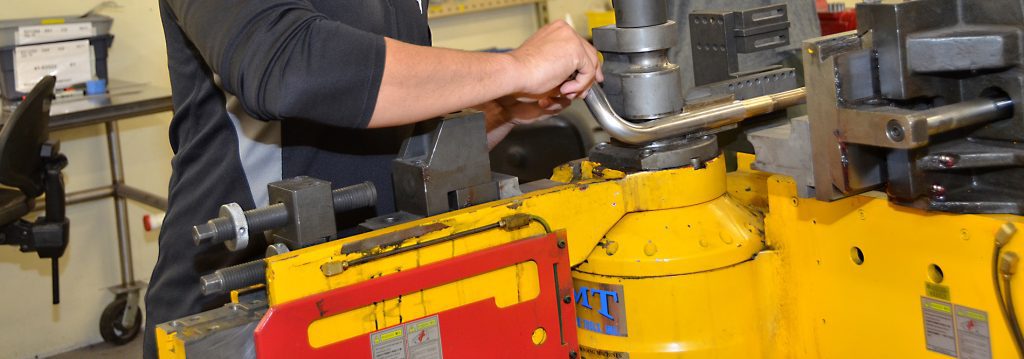
Axenics’ Horn Metric TBRE Hybrid CNC Bender supports precise, repeatable CNC pipe bending for OEM applications. Depending on the specifications and production requirements, CNC bending can reduce the need for welded joints and fittings while providing consistent bends across a production run. We also offer manual bending and welding when CNC bending is not the right fit for a project.
What CNC Pipe Bending Solves for OEMs
Fewer Welds, Fewer Potential Leak Points
CNC pipe bending can reduce the need for some welded joints and fittings, which can be important when dealing with piping for the medical device industry.
Creating the required geometry through bends rather than additional connections can reduce the number of potential leak points in a piping system. It can also reduce the number of individual components that need to be fabricated, joined and inspected. Material, geometry and your specifications determine where bending can replace welded connections or fittings.
This matters most in piping kits and manifolds with several changes of direction, where each additional fitting or weld is another joint that has to be inspected and, potentially, another point of failure over the life of the assembly.
Repeatable Results Across Production Runs
Consistency is another advantage of using a bender for piping kits. CNC pipe bending can provide repeatable results across production runs, with accurate bends for every pipe. Proper CNC pipe bending operation helps maintain specified bend radii and dimensions.
The Horn Metric TBRE Hybrid CNC Bender is capable of mandrel bending and uses programmable controls to reproduce bend sequences. Once a job is set up, the same bend sequence can be repeated as production quantities increase.
Reducing unnecessary joints does not eliminate leak risk however, but it can reduce the number of locations where leaks may develop. We test all completed work before shipment as part of our quality-control process.
Materials and Bend Range
Alloys Handled
CNC pipe bending is a highly automated, computer-controlled process. Our capabilities include stainless steel, copper, brass, aluminum, titanium and Inconel, so OEMs can source a single alloy family or several within the same piping kit or assembly through a single manufacturing partner.
Alloy selection affects more than corrosion resistance. Wall thickness, hardness and grain structure all influence how a given material responds to a controlled bend, and those characteristics vary across the alloys we work with.
These factors, along with the bend-radius and springback behavior ASM International documents for common alloy families, are what Axenics process engineers account for when setting up a job. We’re able to bend pipe and tube ranging from ¼ inch to 2 inches, depending on the material, geometry and tooling required.
Bend Radius and Tolerance Reference
Available bend radii vary by material, outside diameter, part geometry and tooling. This CNC tube bending radius chart shows standard and commonly requested combinations for materials including stainless steel, copper, aluminum and Inconel. Other sizes and radii may require additional tooling.
Material springback also affects how tight a tolerance is achievable, and bending work may call for tolerance allowances depending on the application and material.
Where bending can replace fittings or welded connections within your specified requirements, it may also reduce component count and the fabrication steps associated with those connections.
This related article, Factors Which Affect Tube Bending Results, provides additional detail on springback, wall thickness, bend radius and tooling.
Built for Regulated and High-Purity Applications
Semiconductor and Medical Device Considerations
Semiconductor and medical device manufacturers often work under requirements that go beyond dimensional accuracy. In semiconductor manufacturing, gas and chemical delivery lines may need to meet cleanliness levels referenced in SEMI industry standards, along with documented material traceability.
Piping for medical device applications similarly calls for controlled handling and inspection records that can be tied back to a specific lot or production run.
Axenics’s manufacturing capabilities include Class 100 cleanroom work to support these cleanliness requirements, alongside its standard bending, welding and inspection processes.
Quality Control, Leak Testing, and Documentation
Axenics operates an ISO 9001:2015-certified quality system and performs inspection and leak testing before completed work leaves its facilities. For piping and tubing built to codes such as ASME B31.3, that inspection and testing work supports the documentation you need for your own qualification and audit records, even when we’re executing to your specification.
Project-specific materials, testing methods and documentation requirements such as certificates of conformance, material test reports or dimensional inspection records are established by your specifications and confirmed before production begins. That paper trail is typically what your own quality or purchasing team needs on file to close out incoming inspection (not just a passed test result).
These capabilities support process piping and piping kits used to transport gases, chemicals and other fluids in controlled manufacturing environments.
Manual Bending and Welding, When CNC Isn’t the Fit
CNC bending can provide repeatability across moderate- and higher-volume production, while some geometries, materials, quantities and tooling requirements are better suited to manual bending or welded fabrication.
The Horn Metric TBRE Hybrid CNC bender we use offers both mandrel and roll bending capabilities. CNC bending is not ideal for every project, which is why we also offer manual bending services and joint welding from a team of experts who have been performing pipe bending services for more than 30 years.
Working With Axenics: What to Expect
Axenics works as a build-to-print manufacturing partner, executing pipe and tube bending to your drawings and specifications rather than making the engineering decisions for your system. The process starts when you (or your sourcing/procurement team) provide the drawing package and any applicable specifications up front, then our team reviews it for manufacturability before quoting.
Build-to-Print Process: Specification In, Tested Part Out
Projects run the gamut from a handful of prototype parts to full production-volume runs and more complex assemblies. When a drawing calls for a nonstandard bend, material or configuration, our team can work through the manufacturing requirements with your engineering group to land on the right bending or fabrication process.
We provide bending, welding, assembly, inspection and testing services under one roof, so your piping kits and assemblies don’t have to change hands between vendors to get finished. That matters most in industries like semiconductor and medical device manufacturing, where every step requires documentation. Our precision tube bending and process piping work follow the same process.
Frequently Asked Questions
What is the difference between CNC pipe bending and manual pipe bending?
CNC pipe bending uses programmed equipment to control and repeat bend sequences, making it well suited to parts that require consistency across production runs. Manual bending can be useful for lower-volume work, certain geometries or projects for which CNC tooling is not the best fit.
What is the smallest and largest pipe diameter Axenics can bend?
Axenics's bending capabilities range from ¼ inch to 2 inches. The available bend radius depends on factors including material, outside diameter, geometry and tooling. Our tube bending radius chart provides examples of standard and most-requested combinations, and projects outside those standard combinations can be reviewed on a case-by-case basis.
Does pipe bending eliminate the need for welded joints in a piping system?
Not necessarily. Bending can reduce the number of fittings and welded joints required in many designs, but some assemblies still require welded connections. The appropriate manufacturing process depends on the design and specifications.
What materials can be CNC pipe bent for OEM production?
Axenics works with stainless steel, copper, brass, aluminum, titanium, Inconel and other metal alloys. Material selection and bend requirements come down to the application and specifications, and we can advise on alloy behavior under bending while a project is still being specified.

